Monday, March 10, 2014

3/11 or 3/25 Radial Name Design

Our next project is one that I like because it is packed with art theory! We will cover: radial, symmetry, pattern, line, color, perspective. Wow - but it will be fun!

We will be creating a radial design using our names.  Radial is done in the round. We will work on symmetry - balancing both sides of the design.  Students will start with a swirl of eight curved lines.

They can chose to either use their name or an inspirational word.  I used my oldest son's name for the example.  We will work on block lettering.
Patterns will be added to the spaces without letters.  Students can try adding value to the name sections or just color solid.  The pattern sections will also get color.  Maybe some color theory will be applied here (warm, cool, secondary, primary).
Students can also create a 3D effect to their block letters - like we just did on our cityscape.
Or color them in solid.  This section of name is colored in with markers, the other name sections in color pencils. I show both options, but we will pick one medium for all the letters.  The kids can use markers, color pencils or crayons for this project.

Monday, February 24, 2014

2/25 - City - Creating Space & Perspective

"Space the final frontier..." I couldn't resist a Star Trek quote.  The "space" I am referring to today is one of the seven elements of art.  Space refers to the emptiness (negative) or area between, above, below or within and object (positive). It can be two dimensional which creates "shape". It has height and width and is used in drawings and paintings.  Three dimensional is referred to as "form". It has depth, width and height.  This is found in sculptures, weavings, architecture.  Our project is two dimensional. We will use perspective to create the illusion of depth and volume using lines and color.

We will be creating a simple cityscape using an arrow as the starting point.

Vertical lines are then added.  See how one side of the building bottom is angled?  This is how we will create the depth in our project.
By adding more buildings with angled sides as well as smaller ones in the background, the city begins to create an illusion of being three dimensional.
Details and color are added.  We will create more depth by adding value (light and dark) to the buildings.

Monday, February 17, 2014

One Point Perspective City

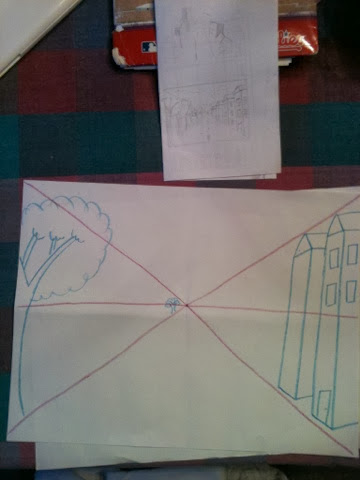
We will be starting a one point perspective city/buildings project.  One point perspective is defined as having one vanishing point on the horizon. It is used for images of roads, rail road tracks, hallways and buildings.  The vanishing point is the point on the horizon where parallel lines appear to meet.

We will start with a horizon line and add an "X" from corner to corner.  The vanishing point is where the lines all meet/cross.
Next we will add trees on one side and buildings on the opposite. The objects will be larger in the foreground and get smaller as they get closer to the horizon.  I will demonstrate how to draw the buildings and trees.
Students will have the option of outlining in sharpie before adding color with colored pencils and/or crayons.
If students do not feel confident doing the above project, here is an easier version of perspective.

Monday, February 10, 2014

Warm/CoolWoven Hearts

Looks like NO snow for tomorrow. This has been a crazy weather month.  We are starting our session with a Valentine inspired project. We will talk about color theory and specifically warm and cool colors which will be used for our project.  I will also give students the option of using complimentary and analogous colors.  Working in oil pastels, students will draw a large heart, pick warm colors (pictured) and fill in the heart with a pleasing design.
A second heart will be drawn and colored in cool colors.  We will give a quick wash of color with paint on the background.
Part two is weaving.  One heart will become the warp. Long slits will be cut to about an inch of the paper edge.
The second heart will be the weave.  Long strips will be cut and detached from the paper.
The two will be woven together for a very cool result.  Note: this is not the above example.  I will cut my example up in class as a demo.

Monday, February 3, 2014

2/4/14- Mola Inspired Work

We are starting out our snowy winter session with a Molas inspired heart painting.  Molas is based on traditional clothing of the Kuna women, an indigenous people of Panama.  The designs are appliqued on cloth. An outline of the object is filled in with color and pattern.  Geometric patterns are traditional. The art form was developed from ancient body painting designs.

Students will be working in watercolors.  They will create a colorful background for their hearts.

They will be given a black piece of paper and draw hearts that are open and connect to the outer edge of the page.  These are carefully cut out.
If the student wants a second layer of color, the black is laid on top of another piece of paper and outlined larger than the black cutout.  This color is then cut out.
Both pieces are then glued together and glued on top of the painted background.

Monday, December 16, 2013

12/16 Value Ornaments

Our last project will be a seasonal one.  I love working on black paper. I think it makes a dramatic piece. We will be using oil pastels to draw in the evergreen branches.  I blended two greens and a dark blue for the needles.  The ornaments will be drawn on white paper with crayons or colored pencils.  We will be adding value.  We worked with value on our very first project in September.  Value is an important art element and worth repeating.  Value makes a flat, 2 dimensional piece look 3 dimensional.  It can help show perspective, light in front, darker in back.  It helps create texture with the play of lights and darks.  When used in a pattern, it leads the viewer's eye around the piece. 

Sorry for the washed out colors.  The sample looks much better in person!

Monday, November 25, 2013

11/26 Mayflower Collage

Since our last class falls right before Thanksgiving, I want to do a seasonal project, but without turkeys.  The Mayflower Collage with 3D elements is what I came up with.

We will look at photos of ships and discuss elements that they have (four masts, wooden, simple...)  We will do a practice sketch before going onto our good sheet of paper.  Students will create an ocean with different colors of torn paper.  The sky will be colored in.  Next the ship will be drawn on a brown bag adding some details with crayons.  The ship will be glued down.  The sails and some additional "waves" will not be glued flat - puffing them up a bit - to create a 3D look.