Landscapes have always been a popular subject matter for artists. There are so many incredible scenes in nature from towering mountains to white sand beaches. This week we are going to take a nature scene and simplify it into an abstract landscape watercolor painting. Abstract art uses color, line and shape (remember those 7 elements of art?) to create the subject or feeling rather than a realistic subject that looks more photo like.
Simplifying is not as easy as it sounds! Kids (and adults) want to get in there and draw every leaf or rock they see. We are going to look at our images and recreate the basic elements in the photo: a curved coastline, mountains, a rock mass using color and our lines. We will not be adding details! We will talk about foreground, middle ground and background and how things are darker in the foreground and lighter the further away they get.
Below are some screen shots of simple landscapes. Following that are two examples of our project.
A simple coastline with a slice of beach and a rock formation. The sky is lighter closer to the horizon and darker towards the top.
A lake with mountains in the distance. Notice the background mountains are lighter and the water in the foreground is darker.
Art classes for homeschool, cyber school and art loving kids. I'm an independent consultant for Social Artworking offering adult paint nights and kid art parties. "What art offers is space — a certain breathing room for the spirit." ~John Updike
Monday, September 30, 2013
Monday, September 23, 2013
9/24 - Bridge Silhouette
The kids have been hearing me talk about the seven elements of art. These are the building blocks of all projects: line, shape, color, texture, form, value and space. Today we will use line, color, shape and texture.
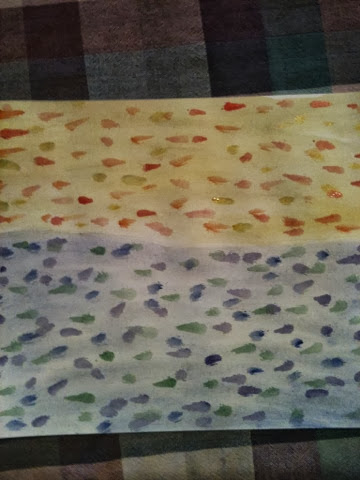
We are working with watercolors. Students will draw a horizon line and lightly paint the water and the sky.
Next we will start to add some texture with short brush strokes of color. We will continue to fill the space until....
It looks something like this. When dry (next class) we will sketch in our bridge choice and paint with black tempera paint to create a silhouette.
Here are some famous works with bridges. Please pardon the screen shots. I do not know how to import images!
French impressionist Claude Monet:
American painter Thomas Kinkade:
Japanese artist Hiroshige:
American futurist painter Joseph Stella:
We are working with watercolors. Students will draw a horizon line and lightly paint the water and the sky.
Next we will start to add some texture with short brush strokes of color. We will continue to fill the space until....
It looks something like this. When dry (next class) we will sketch in our bridge choice and paint with black tempera paint to create a silhouette.
Here are some famous works with bridges. Please pardon the screen shots. I do not know how to import images!
French impressionist Claude Monet:
American painter Thomas Kinkade:
Japanese artist Hiroshige:
American futurist painter Joseph Stella:
Monday, September 16, 2013
9/17/13 - Tessellations
A tessellation is a pattern of repeating shapes that fit together with no gaps. It is a good lesson to introduce line, shape, pattern and color. Tessellation comes from a latin word meaning small stone cube. Very early tessellations were in the form of mosaics. Modern ones come in all different shapes, but they still interlock and have no space in between. Artist M.C. Escher, born in Holland in 1898, is known as the "Modern Father of Tessellations". He became obsessed with filling surfaces with pictures that did not overlap or leave space.
For today's project we will start with a pre-made tracer. It will require some tracing, cutting and taping to have a working piece. Students will also have the option of cutting their own organic shape. I will walk them thru it.
The shape will be traced across the page and continue on each row, making sure the pieces interlock. The photo below show examples of the shapes the students can pick from.
Here are the birds interlocking on the entire page. We will talk about color families (warm, cool, primary, secondary) to help with color selection and how the same color should not touch each other. If students feel confident, they can try and add some value to the project (light to dark).
For today's project we will start with a pre-made tracer. It will require some tracing, cutting and taping to have a working piece. Students will also have the option of cutting their own organic shape. I will walk them thru it.
The shape will be traced across the page and continue on each row, making sure the pieces interlock. The photo below show examples of the shapes the students can pick from.
Here are the birds interlocking on the entire page. We will talk about color families (warm, cool, primary, secondary) to help with color selection and how the same color should not touch each other. If students feel confident, they can try and add some value to the project (light to dark).
Monday, September 9, 2013
9/10 Class - lines
We will start our fall session using lines. Today we will only use curved lines. Students will trace circles onto their paper and then connect the circles with curved lines. The goal is to draw interesting shapes to create a visually pleasing composition.
We will be using oil pastels. They lay down smoothly and blend well. We will discuss color theory - primary, secondary, analogous, complementary) and will work on adding value (light to dark). The finished result is a rather cool abstract piece of art!
Wednesday, June 19, 2013
Art Journaling Workshop - July 2
Looking for a creative way to get your kids to write this summer or to record vacations or events over summer break? I am offering an art journaling workshop on July 2 at Leidy's Church. I have a few spots left in the 9-12pm class and space available in the 12:30-3:30pm class. Cost is $25 and includes a 44 page 5.5"x8" journal. This is appropriate for kids 6 and up. Adults are also welcome to join. I have two moms currently enrolled.
Art journaling is the best of both worlds; art and words. It is a place to practice different art techniques. A place to record your thoughts or write a poem. There are no rules, no mistakes, just creativity.
In this workshop we will be learning to make different backgrounds that will be ready to add ephemera (post cards, maps, brochures, tickets), stamps, collage or paint. We will make pockets, doodle, rip, cut, paint, color, collage to create fun pages for your journal entries.
Here are some examples from a previous workshop:
A few backgrounds:
Using ephemera collected on trips:
A few examples from my journals:
Wrapping paper background.
Photo copy of my hand.
Art journaling is the best of both worlds; art and words. It is a place to practice different art techniques. A place to record your thoughts or write a poem. There are no rules, no mistakes, just creativity.
In this workshop we will be learning to make different backgrounds that will be ready to add ephemera (post cards, maps, brochures, tickets), stamps, collage or paint. We will make pockets, doodle, rip, cut, paint, color, collage to create fun pages for your journal entries.
Here are some examples from a previous workshop:
A few backgrounds:
Using ephemera collected on trips:
A few examples from my journals:
Wrapping paper background.
Photo copy of my hand.
Tuesday, June 11, 2013
Line & Pattern Landscape - Romero Britto
Our lanscape project is based on the bold, playful style of Brazilian Neo Pop artist Romero Britto.
Monday, June 3, 2013
Foreshortening
Foreshortening is a perspective technique used to create the illusion of an object receding into the distance or background. Objects closest to you appear much larger than other parts, sometimes looking distorted.
For our next project we will be using our hands and feet. Students will trace their shoes with their hands positioned on top of the shoes. We will look at the patterns on our shoes and try to duplicate them on our drawings. We will add a small head and body - going over proper feature placement so we don't have eyeballs at the top of the head - to complete the foreshortening. Students will further personalize their projects by adding patterns and color to their clothes and creating a scenario for "falling".
1st Step - hand and feet
2nd step: add head and body
3rd Step - add color, patterns and falling scenario
Results from class today. They look great!!
For our next project we will be using our hands and feet. Students will trace their shoes with their hands positioned on top of the shoes. We will look at the patterns on our shoes and try to duplicate them on our drawings. We will add a small head and body - going over proper feature placement so we don't have eyeballs at the top of the head - to complete the foreshortening. Students will further personalize their projects by adding patterns and color to their clothes and creating a scenario for "falling".
1st Step - hand and feet
2nd step: add head and body
3rd Step - add color, patterns and falling scenario
Results from class today. They look great!!
Subscribe to:
Posts (Atom)


: